Top Banner Advertisement

السبت، 31 مايو 2014

How To Speed Up Antivirus Scans on Windows 8


Most laptops and PCs are equipped with the Windows 8 operating system. It can be a hassle keeping it up to date and optimized. You want to use a nag free anti virus that is easy to use. Technophobes like myself would want to avoid the entire sage all together- no matter how dire the consequences are. In order to enjoy a stress free digital life you will have to explore quite a few DIY processes to be your own Systems administrator.
Most antivirus software will penetrate your hard disk to check for any lingering viruses or incredulous pieces of software. This means that the antivirus will check each piece of data for any viruses or Trojan - regardless if the file is old, new, or temporary. If you have a particularly large hard drive, the antivirus software can take many hours to complete a scan. You can decrease the time it takes for the virus scan to complete by deleting temporary files. As you delete programs and surf the web, pieces of information are embedded into your computer's hard drive. This can reduce the performance of your computer and make it sluggish.
Deleting Temporary Files On Windows 8
With your screen cleared of any inconspicuous Windows or programs, place your cursor to the bottom right of your screen. There will be a search box - this will allow you to search for any kind of program or Windows command on the whim. In the search box, type in "Disk Cleanup". You will see an option pop up saying "Free Disk Space by Deleting Unnecessary Files".
Your computer will usually have one hard disk where it installs most of its programs. If for some reason you have multiple hard drives or if you have an external hard drive that is connected to your desktop or laptop, then you will have to do a disk cleanup on each hard drive. Once the "Free Disk Space by Deleting Unnecessary Files" opens up, use the drop-down menu to select the hard drive that will have its temporary files deleted. The "Disk Cleanup Tool" will start to scan the hard drive and calculate how much free space you will potentially gain. Click on the check boxes then click on the "OK" button. Click on "Delete Files". Windows 8 will then take a couple of moments to delete these temporary files.
Once the deletion process is complete, restart your computer. Restarting the computer will turn off any background processes that may bog down the antivirus scan. You will find that the antivirus program will take a less time to complete the scan. Deleting temporary files can also help dismantle certain trojans or viruses from further infecting your system.
إقرأ المزيد...

College student finds another eBay security flaw, could be used to hijack accounts


eBay
Though eBay told users to change their passwords once the e-commerce giant discovered that hackers compromised a database containing encrypted passwords and other non-financial data, security troubles continue to plague the company. 19-year-old Jordan Lee Jones, a college student and security researcher, discovered a second vulnerability that could be used as a means to hijack user accounts.
Reported by PC World, Jones detailed the vulnerability on his blog on Monday after he didn’t hear back from eBay on Friday regarding the flaw. The second vulnerability could allow a hacker to fill a page with malicious code that would take your cookies. This would then allow the hacker to gain access to your account.
Jones said that “eBay should be on top of their stuff.” The company asks security researchers to withhold their findings until the flaw is fixed, though it’s not illegal for researchers to disclose a vulnerability. Jones was added to a list of security researchers that have helped eBay after he discovered a vulnerability that allowed him to deface part of the website. It has taken measures to defend itself against that vulnerability, though eBay has not uttered a word about Jones’ recently-discovered vulnerability to this point.


Read more: http://www.digitaltrends.com/computing/college-student-finds-another-ebay-security-flaw-used-hijack-accounts/#ixzz33HL2r1ys
Follow us: @digitaltrends on Twitter | digitaltrendsftw on Facebook
إقرأ المزيد...

MSI’s new Nightblade Z97 barebones desktop will feature Intel’s newest chipset

MSI Nightblade Z97

If you’re a LAN event junkie, then you’re likely all too familiar with the pain that comes with lugging your desktop from one PC gaming competition or another. Even if your rig has a handle or two on it, it can still be quite uncomfortable to schlep around while having to a drag a 20-40 pound gaming system with you. And who wants to carry a hand-truck to help you with that? That gives you two things to drag around with you.
For that reason, perhaps your next gaming rig should consist of MSI’s Nightblade Z97 small form factor barebones PC. With support for mini-ITX motherboards, the Nightblade Z97 offers the portability of an SSF system, while sporting enough real estate inside to accommodate high-end gaming hardware.
The Nightblade Z97 features a brushed aluminum finish and is coated in black all around; no zany yellows, oranges, or blues here. The Nightblade looks ninja-esque, and when it comes to gaming, it’s aesthetics suggest that the system is all about taking care of business.
At the top of the system’s front panel, you’ll find a foursome of USB ports, audio and microphone jacks, along with the rig’s power button. On the bottom of the front panel is a stand that also doubles as the Nightblade Z97′s handle. An LED fan between the handle and the bottom of the front panel emits a fearsome-looking red glow.
Perhaps best of all, as its name suggests, the Nightblade Z97 can feature an Intel Z97-based motherboard. The Z97 chipset is compatible with both current Intel Haswell and next-gen Broadwell CPUs, support faster storage technologies like SATA Express and M.2, and more. You can learn more about what Z97 motherboards mean for the world of computing here. It’s worth noting that MSI will also offer the Nightblade Z97 with H97-based motherboard chipsets as well though.
This is unclear at the moment, but considering that MSI refers to the Nightblade Z97 barebones system, it will likely ship without some core components. This can include any combination of CPU, graphics card, memory, and/or hard drive. Just keep that in mind before you decide that you’re dead set on getting one.
MSI Nightblade Z97 pricing and availability details are unknown at the moment, but we’re sure to find out more once Computex 2014 kicks off on June 3 next week.


Read more: http://www.digitaltrends.com/computing/msis-nightblade-z97-sff-desktop-will-feature-intels-new-z97-chipset/#ixzz33HJgWt9O
Follow us: @digitaltrends on Twitter | digitaltrendsftw on Facebook
إقرأ المزيد...

Inexpensive Spray Method Delivers High-Quality Graphene Layer

Supersonic Graphene Spray
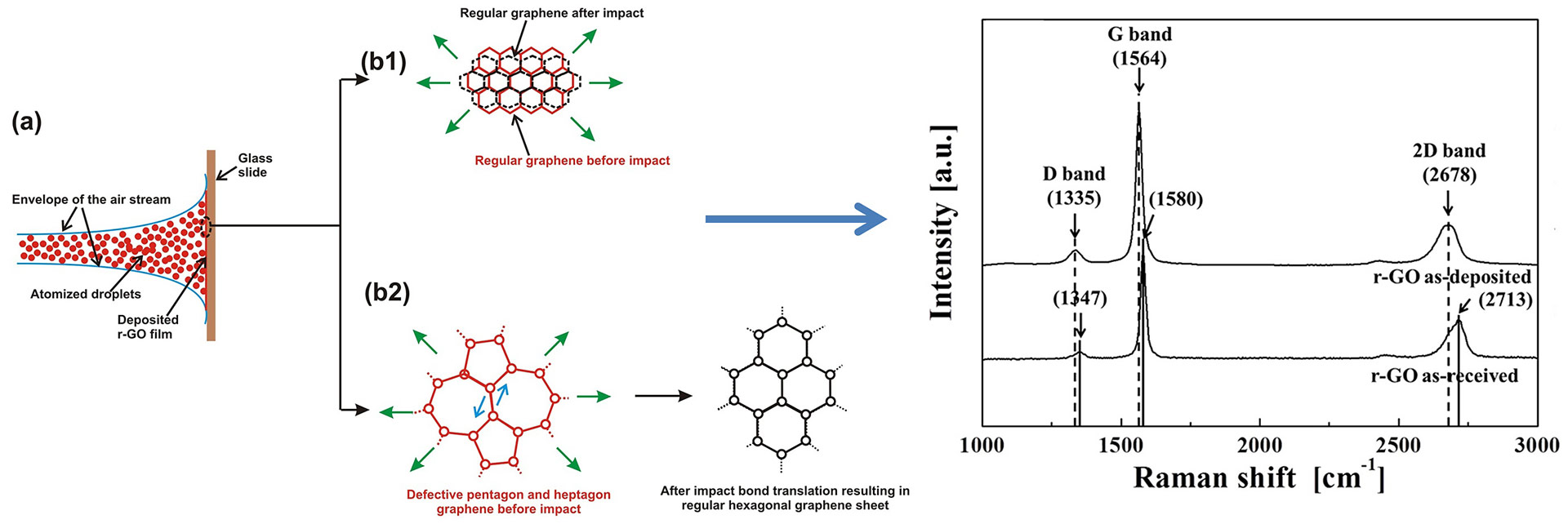
(Click on image to see full image) Using a supersonic spray, graphene flakes with deformed pentagonal and heptagonal structures stretch on impact and spring into a perfect hexagonal graphene lattice. This opens the way to scale up from the microscopic to large scale applications. Photo credit: Suman Sinha-Ray.
Using an inexpensive spray method, researchers from the University of Illinois at Chicago and Korea University have developed a supersonic spray that delivers a high-quality graphene layer.
A simple, inexpensive spray method that deposits a graphene film can heal manufacturing defects and produce a high-quality graphene layer on a range of substrates, report researchers at the University of Illinois at Chicago and Korea University.
Graphene, a two-dimensional wonder-material composed of a single layer of carbon atoms, is strong, transparent, and an excellent conductor of electricity. It has potential in a wide range of applications, such as reinforcing and lending electrical properties to plastics; creating denser and faster integrated circuits; and building better touch screens.
Although the potential uses for graphene seem limitless, there has been no easy way to scale up from microscopic to large-scale applications without introducing defects, says Alexander Yarin, UIC professor of mechanical and industrial engineering and co-principal investigator on the study.
“Normally, graphene is produced in small flakes, and even these small flakes have defects,” Yarin said. Worse, when you try to deposit them onto a large-scale area, defects increase, and graphene’s useful properties — its “magic” — are lost, he said.
Yarin first turned to solving how to deposit graphene flakes to form a consistent layer without any clumps or spaces. He went to Sam S. Yoon, professor of mechanical engineering at Korea University and co-principal investigator on the study.
Yoon had been working with a unique kinetic spray deposition system that exploits the supersonic acceleration of droplets through a Laval nozzle. Although Yoon was working with different materials, Yarin believed his method might be used to deposit graphene flakes into a smooth layer.
Their supersonic spray system produces very small droplets of graphene suspension, which disperse evenly, evaporate rapidly, and reduce the tendency of the graphene flakes to aggregate.
But to the researchers’ surprise, defects inherent in the flakes themselves disappeared, as a by-product of the spray method. The result was a higher quality graphene layer, as found in the analysis by another collaborator, Suman Sinha-Ray, senior researcher at United States Gypsum and UIC adjunct professor of mechanical and industrial engineering.
The researchers demonstrated that the energy of the impact stretches the graphene and restructures the arrangement of its carbon atoms into the perfect hexagons of flawless graphene.
“Imagine something like Silly Putty hitting a wall — it stretches out and spreads smoothly,” said Yarin. “That’s what we believe happens with these graphene flakes. They hit with enormous kinetic energy, and stretch in all directions.
“We’re tapping into graphene’s plasticity — it’s actually restructuring.”
Other attempts to produce graphene without defects or to remove flaws after manufacture have proved difficult and prohibitively expensive, Yarin said.
The new method of deposition, which allows graphene to “heal” its defects during application, is simple, inexpensive, and can be performed on any substrate with no need for post-treatment, he said.
Yarin and his Korean colleagues hope to continue their successful collaboration and foster the development of industrial-scale applications of graphene.
Jung-Jae Park, Jung-Gun Lee and You-Hong Cha of Korea University; Sang-Hoon Bae and Jong-Hyun Ahn of Yonsei University; and Yong Chae Jung and Soo Min Kim of the Korea Institute of Science and Technology are co-authors on the paper.
Initial support for the collaboration between Yarin’s group at UIC and Yoon’s group at Korean University was provided by the Office of International Affairs Nuveen International Development Fund at UIC and by Korea University.
Publication: Do-Yeon Kim, et al., “Self-Healing Reduced Graphene Oxide Films by Supersonic Kinetic Spraying,” Advanced Functional Materials, 2014; doi: 10.1002/adfm.201400732
إقرأ المزيد...

New Efficiency Record for Quantum-Dot Photovoltaics

Quantum Dot Photovoltaics Set New Record for Efficiency
Researcher displays a sample of the record-setting new solar cell on the MIT campus. Photo courtesy of Chia-Hao Chuang
By engineering the band alignment of the quantum dot layers through the use of different ligand treatments, researchers at MIT set a new record for efficiency in quantum-dot photovoltaics.
Solar-cell technology has advanced rapidly, as hundreds of groups around the world pursue more than two dozen approaches using different materials, technologies, and approaches to improve efficiency and reduce costs. Now a team at MIT has set a new record for the most efficient quantum-dot cells — a type of solar cell that is seen as especially promising because of its inherently low cost, versatility, and light weight.
While the overall efficiency of this cell is still low compared to other types — about 9 percent of the energy of sunlight is converted to electricity — the rate of improvement of this technology is one of the most rapid seen for a solar technology. The development is described in a paper, published in the journal Nature Materials, by MIT professors Moungi Bawendi and Vladimir Bulović and graduate students Chia-Hao Chuang and Patrick Brown.
The new process is an extension of work by Bawendi, the Lester Wolfe Professor of Chemistry, to produce quantum dots with precisely controllable characteristics — and as uniform thin coatings that can be applied to other materials. These minuscule particles are very effective at turning light into electricity, and vice versa. Since the first progress toward the use of quantum dots to make solar cells, Bawendi says, “The community, in the last few years, has started to understand better how these cells operate, and what the limitations are.”
The new work represents a significant leap in overcoming those limitations, increasing the current flow in the cells and thus boosting their overall efficiency in converting sunlight into electricity.
Many approaches to creating low-cost, large-area flexible and lightweight solar cells suffer from serious limitations — such as short operating lifetimes when exposed to air, or the need for high temperatures and vacuum chambers during production. By contrast, the new process does not require an inert atmosphere or high temperatures to grow the active device layers, and the resulting cells show no degradation after more than five months of storage in air.
Bulović, the Fariborz Maseeh Professor of Emerging Technology and associate dean for innovation in MIT’s School of Engineering, explains that thin coatings of quantum dots “allow them to do what they do as individuals — to absorb light very well — but also work as a group, to transport charges.” This allows those charges to be collected at the edge of the film, where they can be harnessed to provide an electric current.
The new work brings together developments from several fields to push the technology to unprecedented efficiency for a quantum-dot based system: The paper’s four co-authors come from MIT’s departments of physics, chemistry, materials science and engineering, and electrical engineering and computer science. The solar cell produced by the team has now been added to the National Renewable Energy Laboratories’ listing of record-high efficiencies for each kind of solar-cell technology.
The overall efficiency of the cell is still lower than for most other types of solar cells. But Bulović points out, “Silicon had six decades to get where it is today, and even silicon hasn’t reached the theoretical limit yet. You can’t hope to have an entirely new technology beat an incumbent in just four years of development.” And the new technology has important advantages, notably a manufacturing process that is far less energy-intensive than other types.
Chuang adds, “Every part of the cell, except the electrodes for now, can be deposited at room temperature, in air, out of solution. It’s really unprecedented.”
The system is so new that it also has potential as a tool for basic research. “There’s a lot to learn about why it is so stable. There’s a lot more to be done, to use it as a testbed for physics, to see why the results are sometimes better than we expect,” Bulović says.
A companion paper, written by three members of the same team along with MIT’s Jeffrey Grossman, the Carl Richard Soderberg Associate Professor of Power Engineering, and three others, appears this month in the journal ACS Nano, explaining in greater detail the science behind the strategy employed to reach this efficiency breakthrough.
The new work represents a turnaround for Bawendi, who had spent much of his career working with quantum dots. “I was somewhat of a skeptic four years ago,” he says. But his team’s research since then has clearly demonstrated quantum dots’ potential in solar cells, he adds.
Arthur Nozik, a research professor in chemistry at the University of Colorado who was not involved in this research, says, “This result represents a significant advance for the applications of quantum-dot films and the technology of low-temperature, solution-processed, quantum-dot photovoltaic cells. … There is still a long way to go before quantum-dot solar cells are commercially viable, but this latest development is a nice step toward this ultimate goal.”
The work was supported by the Samsung Advanced Institute of Technology, the Fannie and John Hertz Foundation, and the National Science Foundation.
Publications:
  • Chia-Hao M. Chuang, eta l., “Improved performance and stability in quantum dot solar cells through band alignment engineering,” Nature Materials, 2014; doi:10.1038/nmat3984
  • Patrick R. Brown, et al., “Energy Level Modification in Lead Sulfide Quantum Dot Thin Films Through Ligand Exchange,” ACS Nano, 2014; doi:10.1021/nn500897c
إقرأ المزيد...

Printable Robots That Self-Assemble When Heated

New Algorithms and Electronics Could Enable Printable Robots that Self Assemble
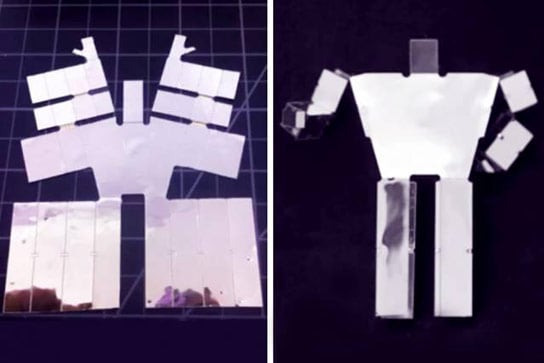
Using new algorithms and electronic components, researchers demonstrate the promise of printable robotic components that, when heated, automatically fold into prescribed three-dimensional configurations.
Printable robots — those that can be assembled from parts produced by 3-D printers — have long been a topic of research in the lab of Daniela Rus, the Andrew and Erna Viterbi Professor of Electrical Engineering and Computer Science at MIT.
At this year’s IEEE International Conference on Robotics and Automation, Rus’ group and its collaborators introduce a new wrinkle on the idea: bakable robots.
In two new papers, the researchers demonstrate the promise of printable robotic components that, when heated, automatically fold into prescribed three-dimensional configurations.
One paper describes a system that takes a digital specification of a 3-D shape — such as a computer-aided design, or CAD, file — and generates the 2-D patterns that would enable a piece of plastic to reproduce it through self-folding.
The other paper explains how to build electrical components from self-folding laser-cut materials. The researchers present designs for resistors, inductors, and capacitors, as well as sensors and actuators — the electromechanical “muscles” that enable robots’ movements.
“We have this big dream of the hardware compiler, where you can specify, ‘I want a robot that will play with my cat,’ or ‘I want a robot that will clean the floor,’ and from this high-level specification, you actually generate a working device,” Rus says. “So far, we have tackled some subproblems in the space, and one of the subproblems is this end-to-end system where you have a picture, and at the other end, you have an object that realizes that picture. And the same mathematical models and principles that we use in this pipeline we also use to create these folded electronics.”
Both papers build on previous research that Rus did in collaboration with Erik Demaine, another professor of computer science and engineering at MIT. This work explored how origami could be adapted to create reconfigurable robots.
All the angles
The key difference in the new work, explains Shuhei Miyashita, a postdoc in Rus’ lab and one of her co-authors on both papers, is a technique for precisely controlling the angles at which a heated sheet folds. Miyashita sandwiches a sheet of polyvinyl chloride (PVC) between two films of a rigid polyester riddled with slits of different widths. When heated, the PVC contracts, and the slits close. Where edges of the polyester film press up against each other, they deform the PVC.
Imagine, for instance, a slit in the top polyester film and another parallel to it in the bottom film. But suppose, too, that the slit in the top film is narrower than that on the bottom. As the PVC contracts, the edges of the top slit will press against each other, but there will still be a gap between the edges of the bottom slit. The entire sheet will then bend downward until the bottom edges meet as well. The final angle is a function of the difference in the widths of the top and bottom slits.
But producing the pattern of slits is not as simple as just overlaying them on an origami crease pattern and adjusting the widths accordingly, Rus says. “You’re doing this really complicated global control that moves every edge in the system at the same time,” she says. “You want to design those edges in such a way that the result of composing all these motions, which actually interfere with each other, leads to the correct geometric structure.”
ByoungKwon An, another of Rus’ students, is lead author on the paper describing the system for interpreting 3-D images. He’s joined by Rus, Miyashita, Demaine, and five other researchers both at MIT and in the lab of professor Robert Wood at Harvard University.
Current events
Miyashita is lead author on the other paper, whose coauthors include, in addition to Rus, researchers at the University of Zurich and the University of Tokyo.
In that paper, the researchers describe using a polyester coated with aluminum to create foldable electronic components. Miyashita designed those components by hand, since it was necessary to prescribe not just their geometric properties but also their electrical properties. The sensor Miyashita designed looks kind of like a small accordion. Each of the accordion folds contains a separate resistor, and when the folds are compressed, the total resistance changes proportionally, with a measurable effect on a current passing through the sensor.
The actuator — which would enable a robot to move — is a foldable coil, which would need to be augmented with a pair of iron cylinders that could be magnetized by an electrical current. Aluminum isn’t a good enough conductor to yield an actuator that exerts much force, but a copper-coated polyester should do the trick
إقرأ المزيد...

الأربعاء، 28 مايو 2014

Sandia bullet is a hit رصاصة ذاتية التوجيه


tab3.net

رصاصة ذاتية التوجيه
Self-Guided Bullet
PSC0612_HL_019

ابتكر الباحثون فى مختبر  ’’Sandia National’’ رصاصة بتوجيه ذاتي . الرصاصة قادرة على إصابة الهدف من على بعد ميل واحد (حوالي 2000 متر).  حجم الرصاصة 4 بوصة مزودة بمحركات صغيرة توجهالزعانف الصغيرة التي تسترشد بها إلى هدفه. 

لسنوات عدة حاول الكثيرون لإيجاد طريقة للتحكم في مسار الرصاصات، وقد كانت الإجابة انه لا يمكن ان نقوم بذلك. السبب في ذلك يعود إلى اذا كانت الرصاصة تدور حول محورها في حركة مغزلية فإنها تكون مستقرة ولا يمكن تطبيق قوة كافية لتحيدها عن محور دورانها. السر هنا ان الرصاصة لا تدور حول محروها ومع التكنولوجيا المضافة لها يمكن التحكم بمسارها والتحكم بمكان وصولها.

الرصاصة من العيار 50 تمتلك مجس استشعاري ضوئي في مقدمتها يبحث عن بقعة الليزر على الهدف. تزود بطارية معالج 8-bit يعمل على الغوريثم تحكم لتحريك الرصاصة وضبط اتجاهها بمعدل 30 مرة في الثانية. يعمل موتور على تحريك أربعة مراوح صغيرة جدا لضبط زاوية توجيه الرصاصة.


الرصاصة تتعقب الأهداف باستخدام جهاز استشعار بصري في أنف المقذوف الصورة في الأسفل تبين اختبار ميداني على الرصاصة وهى في طريقها ألي الهدف.

tab3.net4

في حال اكتمال الاختبار و نجاح تصنيع هذه الرصاصة بهذه التقنية فسيتم توفير هذا النوع من الرصاص للاستخدام في الجيش و الشرطة و غيرها من المؤسسات الحكومية .

tab3.net42

واليكم الفيديو التالي 


إقرأ المزيد...